
The 1.4% decline projected for 2025 is driven by a 5.6% (72,000) dip in the strength of railway employees to 1.2 million by next year.

Uttarakhand saw the sharpest decline (of 11 per cent) in the "total persons engaged" in manufacturing in the worst-hit pandemic year of 2020-21 as industrial units shut shop, according to the latest Annual Survey of Industries (ASI) data, released by the Ministry of Statistics and Programme Implementation (MoSPI). This was followed by the decline in the workforce in states such as Jharkhand (8.9 per cent), West Bengal (8.3 per cent), Kerala (8 per cent), and Karnataka (7.8 per cent). The "total persons engaged" in an enterprise is defined as the sum of directly employed workers, supervisory or managerial workers, and the unpaid family members who might be engaged in the enterprise.

After the government's online monitoring system for the import of electronic hardware items went live on November 1, inbound shipments of laptops and tablets slipped in November to a nine-month low at $225 million, contracting 17.15 per cent year-on-year. This decline was primarily driven by reduced imports from Singapore (down 43.7 per cent), Hong Kong (down 27.4 per cent), and China (down 14 per cent), according to the data released by the commerce department. China accounts for approximately 83 per cent of such imports.

With India's inclusion in global bond indices starting next financial year, the central government believes there will be greater scope for shifting to borrowings via long-term government securities (G-sec) from short-term instruments. This change may be factored into the FY25 interim Budget. "While this has been our focus, the inclusion of India in global bond indices gives us the opportunity to accelerate the shift towards longer tenure G-secs," an official said, requesting anonymity.

The ministry of finance is likely to assume crude oil price to remain within $85 per barrel while estimating subsidies for the Interim Budget 2024-25 (FY25), to be presented on February 1. Brent crude prices moved up on Thursday, ending at $78.9 per barrel. Crude oil and cooking gas prices, which move in tandem, impact fertiliser and cooking gas subsidies, constituting 53 per cent of the government's total subsidies.

'Victims of terrorism do not sit together with its perpetrators to discuss terrorism.'

The Interim Budget for 2024-25 (FY25) to be presented on February 1 is likely to assume 10-10.5 per cent nominal gross domestic product (GDP) growth against 8.9 per cent estimated for FY24 by the National Statistical Office (NSO). "We were waiting for the First Advance Estimates GDP numbers for FY24. "We will finalise the nominal GDP growth assumption for FY25 Interim Budget in a couple of days.

'We will see a lot of investments from the private sector.' 'As long as we are not impacted by some global events, I think we will be in a strong place.'

The International Monetary Fund (IMF) warned on Tuesday that India's general government debt (comprising both central and state government debt) could exceed 100 per cent of gross domestic product (GDP) in the medium term. It also cautioned that long-term debt sustainability risks are high due to the significant investment required to meet India's climate change mitigation targets. The Indian government, however, disagreed, arguing that risks from sovereign debt are extremely limited as it is predominantly denominated in domestic currency.

'India's emergence as a top crypto market comes despite a regulatory and tax environment that can be challenging for the industry to navigate.'

But the government will present a second tranche of Supplementary Demands for Grants during the Budget session of Parliament in February, when it can seek additional spending.

India's import of personal computers, including laptops and tablets, shot up in September by 42 per cent to $715 million, reversing a year-long downward trend after the government announced it would impose import restrictions on such electronic hardware items in August. The rise in such imports were led by the largest source China (33 per cent) and Singapore (188 per cent), according to data released by the commerce department. On August 3, the Centre had announced it was planning to bring seven products in the information technology hardware segment, such as personal computers, micro computers, mainframe computers, super computers, computer systems and data processing units under the 'restricted' label.

The government has exhausted only 39 per cent of its fiscal deficit target in the first half of FY24.
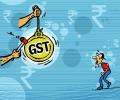
Over 100,000 small and medium-sized businesses are non-compliant with e-invoicing norms under the goods and services tax (GST) regime, a mandatory requirement for businesses with an annual turnover of over Rs 5 crore. E-invoicing provides real-time access to invoices that are prepared by the supplier on the purchase of goods, allowing faster accessibility to input tax credit, thereby limiting the manipulation of fake credit as it has to be generated before the transaction. "The default has been reported mainly in businesses with a turnover between Rs 5 crore and Rs 20 crore," a senior official informed

Taking both direct and indirect taxes, the gross collection is expected to grow 10.45 per cent to Rs 33.61 trillion in 2023-2024.

The Centre could further moderate its divestment target for 2024-25 (FY25), as it does not expect large receipts from asset sales - except some ongoing strategic ones, including IDBI Bank, which could spill over into next financial year. Also, it may drastically reduce its FY24 divestment target of Rs 51,000 crore. "We are still evaluating the Budget estimates for FY25. "New big-ticket asset sales are unlikely.

'This year's detection of frauds and probable recovery will be mainly driven by several compliance measures put in place, and amendments made to the GST regime to plug revenue leakages particularly in new-edge sectors.'

Extreme poverty in India declined by 38 million in 2021 to 167.49 million after a surge in the two preceding years, but remained above the 2018 level, the latest World Bank data shows. While for most countries poverty rose in 2020, when the Covid-19 pandemic hit the global economy, the data shows poverty shot up in India a year earlier in 2019 to 176.09 million from 151.79 million in 2018, the lowest pre-pandemic count. India's poverty rate at 11.9 per cent in 2021 also remained higher than the 2018 level of 11.09 per cent, though easing from 14.72 per cent in 2020.
The Union government's finances witnessed significant improvement in August after a stressful first four months of the current fiscal year. India's gross tax revenue, comprising both direct and indirect taxes, for the first five months of 2023-24 surged 16.5 per cent year-on-year (Y-o-Y) to Rs 11.8 trillion. During the April-July period, gross tax revenue increased by a mere 2.8 per cent compared to the Budget Estimate of 12.1 per cent growth for FY24.

The Union government's revenue from securities transaction tax (STT) is on track to exceed its Budget projection for the current fiscal year, with the mop-up already surpassing 50 per cent of the annual estimate. Provisional figures reveal that the Centre has collected approximately Rs 14,000 crore in the first half of this fiscal year up to September, according to a government official. This amount exceeds half of the full-year target of Rs 27,625 crore set for FY24.
 © 2026 Rediff.com - Investor Information - Advertise with us - Disclaimer - Privacy Policy - Sitemap - Feedback - About us - Terms of use - Grievances